

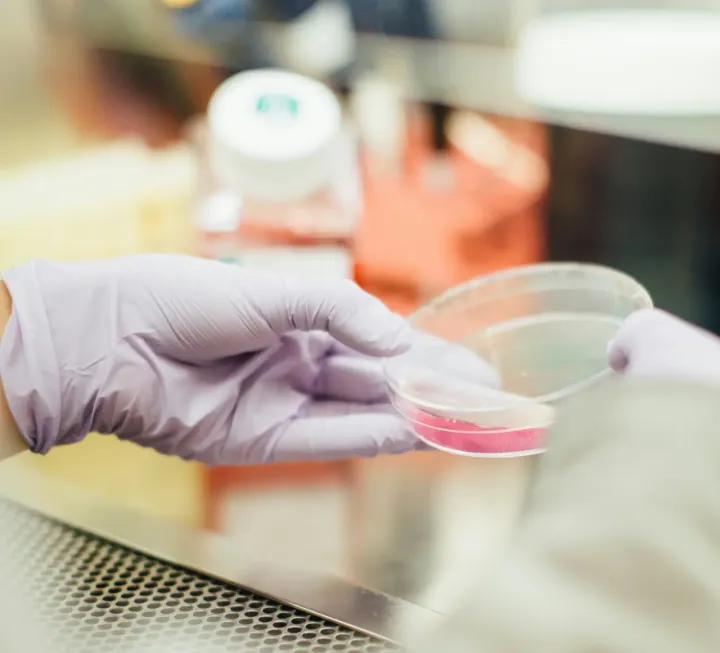
If you have had blood drawn in the last decade, there is a good chance it went to a comprehensive metabolic panel. Fourteen analytes, one vial, one moment in time. It is one of the most ordered tests in medicine, and it works, which is exactly why almost nobody questions its two structural limits.
It requires breaking skin. And it tells you about a single instant.
Two of the fourteen analytes on that panel, chloride and sodium, are measured commercially today by a soft patch worn on the arm, continuously, through a shift or a training session, without a needle or a clinic. That is not a research result. It is a shipping product. The interesting question is what the rest of the panel looks like from here.
What the needle actually costs you
The vein is not the problem. The consequences of needing one are.
You get episodes, not trajectories. A creatinine value tells you where a patient stood on Tuesday morning. It cannot tell you what happened in the six weeks between infusion visits, or whether a value drifted for three weeks before it crossed a threshold. Clinical chemistry has always been a sequence of still frames, and everyone has quietly agreed to reason about motion from them.
You get compliance-limited data. Every blood draw needs a phlebotomist, a site, and a patient who shows up. In decentralized trials and remote patient monitoring, that requirement is the single largest source of missing data, and the missingness is not random. The people who miss draws are frequently the people the data was meant to protect.
You get measurement away from exposure. A metabolic swing, a medication side effect, a flare: they happen at home, at work, in the ordinary hours between study visits. The measurement happens afterward, in a clinic, once the physiology has already begun to normalize. You are inferring the event from its aftermath.
None of this is an argument that blood chemistry is wrong. It is an argument that a needle-based panel is structurally incapable of answering a category of question that matters enormously, and that the question is about time, not accuracy.
Why sweat, specifically
Sweat is not the only non-invasively accessible biofluid, but is the one with the most useful properties for continuous measurement.
It is secreted continuously and under a known stimulus, which means the rate of production is itself a signal rather than a nuisance variable. It is accessible without breaking the skin barrier. And it carries a genuinely broad chemistry, including electrolytes, metabolites, proteins, and hormones, rather than a single class.
In contrast, saliva is more susceptible to contamination mainly by food intake. Tears are hard to collect and harder to standardize. Interstitial fluid requires microneedles. Sweat sits in a category of its own: sufficiently rich to be interesting and accessible enough to be continuous for many use cases.
Where the overlap actually is, including where it isn’t
Here is the honest map against the basic and comprehensive metabolic panel.
| Panel analyte | Status in sweat sensing |
|---|---|
| Chloride | Commercially deployed |
| Sodium | Commercially deployed |
| Urea / creatinine | In active development |
| Calcium | Research stage |
| Glucose, potassium, CO₂, albumin, ALT/AST/ALP, bilirubin | Not addressed |
Read that last row carefully, because it is the row most companies in this space would leave out. Sweat does not replace a metabolic panel. Liver enzymes are not in sweat at usable concentrations. Sweat glucose has been pursued for years and remains a genuinely hard problem. Anyone who tells you a patch is about to replace the blood draw is selling something.
The right frame is not replacement. It is a different axis: a partial overlap of the same clinical chemistry, measured continuously, in the environment where the physiology is actually happening.
The overlap runs both directions. Sweat carries information a blood panel structurally cannot contain:
- Sweat rate itself: a direct measure of fluid loss, with no serum equivalent.
- Person-to-person variance in electrolyte loss. Across 282 wear sessions in one field deployment, sodium loss varied by as much as 3.8× between two people doing comparable work under the same conditions. That same variability shows up in patients, since no two people clear fluid or electrolytes identically, and neither a uniform protocol nor a single blood draw calibrated to a population average can see the difference.
- Stressor differentiation. Published mass-spectrometry work has identified candidate sweat markers that distinguish why a physiological stress response is occurring (heat, humidity, exertion, or other load) and, critically, those markers largely did not track heart rate or core temperature. ⚑ Candidate markers, n=20, exploratory. Not a validated or deployed capability. That is precisely the kind of signal a decentralized trial or a remote monitoring program needs: not just that something changed, but a mechanistic clue as to why. They add information rather than restating it. That orthogonality is the whole point.
How an analyte earns its way onto a patch
The gap between “detectable in sweat” and “measurable in the field” is where this industry loses its credibility. There are five rungs, and most published analytes are on the first.
- Detectable in the literature. Mass spectrometry finds the molecule in collected sweat. This is where the large majority of sweat’s chemistry currently sits. The literature already describes more than eighty electrolytes and metabolites, and Epicore’s own Discovery Patch research has separately cataloged over 800 proteins and 32,000 endogenous peptides in sweat. Breadth was never the constraint.
- Analytically validated. The measurement agrees with a reference method, reproducibly, across people.
- Reduced to a wearable form factor. Lab instrumentation becomes on-skin chemistry that survives motion, heat, and a full shift.
- Clinically validated. The measurement predicts something that matters, in the population it will be used on.
- Deployed and supported at scale. Manufacturing, data infrastructure, and a channel that puts it on real people.
Electrolytes such as sodium and chloride represent strong target biomarkers across several use-cases. Recent work published in npj Digital Medicine paired automated iontophoresis with a microfluidic colorimetric patch read by a smartphone camera. No external instrumentation was required. Across 55 subjects at a single pediatric CF center, results showed strong agreement with standard-of-care sweat testing.
That is rung four of five, and it took years of data collection and blinded studies with clinical leaders.
Beyond the panel: measuring the drug, not just the disease
The aforementioned biomarker targets are endogenous physiological markers produced by the human body. These are signals that we can now effectively monitor through sweat. There is a second category that is equally compelling: exogenous therapeutic agents. Rather than measuring the physiological response to a therapy, we can potentially measure the therapy itself. Its presence, concentration, pharmacokinetics, and ultimately its relationship to patient response can be measured in real time and in ambulatory settings.
A drug and its metabolites, as they circulate and clear over a dosing cycle, face the same invasive needle-and-snapshot problem described throughout this piece. A trough level drawn at a clinical visit is asked to stand in for weeks of dosing, adherence, metabolism, and exposure that it never actually observed. Continuous, non-invasive measurement of a drug and its metabolites between visits, pharmacovigilance rather than diagnosis, is one direction we are actively investigating with pharmaceutical partners.
It is worth calling out that the same five-rung skepticism applies when the target is the drug itself or its metabolites, rather than the patient’s baseline chemistry. If a trough level drawn at a clinic visit is the only view you have between doses, you face the same structural gap this entire piece describes, only now it is a gap in understanding your own therapy rather than ours.
The chemistry is not the hard part
This is the part the field consistently gets backwards.
There is excellent sweat-sensing science underway in academic labs worldwide: at Caltech, University of Cincinnati, Northwestern University, and dozens of others worldwide. Detection chemistry for a remarkable number of analytes already exists in the literature. If the bottleneck were chemistry, this market would have arrived a decade ago.
The bottleneck is everything downstream of it. A sweat biomarker becomes useful only when three things exist simultaneously:
- A form factor that survives real conditions. Microfluidic sweat capture that works on a person moving through a twelve-hour shift in 100°F heat, or through six weeks of a decentralized trial with no technician present, is a manufacturing problem, not a chemistry problem, and it is solved at scale or not at all.
- An enterprise data platform behind it. A number on a patch is worthless. A number that reaches a clinician’s or a sponsor’s dashboard in time to change a decision, inside an organization’s security and privacy posture, is an entirely different artifact. Most sensing companies discover this after they have built the sensor.
- A live commercial channel. Field validation requires deployment, and deployment requires customers using the platform for something they will pay for today. Every new analyte that reaches rung four does so by riding infrastructure that hydration monitoring, and now clinical research, has already paid for.
Very few organizations hold all three at once. Most of this field holds one, usually the chemistry, and spends years discovering that the other two are the expensive parts. Epicore has spent those years in reverse order: shipping electrolyte and hydration monitoring at volume across industrial, athletic, and defense deployments, then bringing that same manufacturing and data infrastructure into clinical research (decentralized trials, pediatric diagnostic validation, sponsor-run biomarker studies) through Discovery Patch. The platform and the channel came first. The clinical analytes are being added onto infrastructure that already exists, not built from a blank sheet for each one.
That sequence is not a marketing position. It is the reason a fifth rung is reachable at all.
FAQ
FREQUENTLY ASKED QUESTIONS
A comprehensive metabolic panel is a blood test measuring 14 analytes from a single vial, covering electrolytes, kidney and liver function, blood sugar and protein levels. It is one of the most frequently ordered tests in medicine. It requires a needle, and it reports a single moment in time.
Sweat carries electrolytes, metabolites, proteins and hormones, and it reports them continuously rather than at a single moment. Sodium and chloride are measured commercially today through a patch worn on the arm. Sweat also reveals fluid loss rate directly, which is information no blood test contains.
Blood is chemically richer, but you can only sample it episodically and you need to break the skin to do it. Sweat is chemically narrower but continuously accessible, and it is produced under a stimulus you can control. The practical difference is time: blood gives you still frames, sweat gives you motion.
Chloride and sodium are commercially deployed in wearable form now. Urea and creatinine are in active development, and calcium sits at research stage. The wider literature describes more than eighty electrolytes and metabolites in sweat, plus hundreds of proteins and thousands of peptides, most of which are not yet measurable outside a laboratory.
Yes. Sweat sodium and chloride are measured continuously today by a soft microfluidic patch worn on the upper arm, through a work shift or a training session, with no needle and no clinic visit. This is a shipping product rather than a research result, and it covers two of the fourteen analytes on a standard metabolic panel.
Continuous biomarker monitoring measures a physiological signal repeatedly over hours or days rather than once at a clinic visit. It shows the trajectory of a value, including whether it drifted for weeks before crossing a threshold. Conventional lab chemistry produces a sequence of still frames and asks clinicians to reason about motion from them.
Because that is where the physiology happens. A metabolic swing, a medication side effect or a flare occurs at home or at work, and the measurement happens afterward in a clinic once things have begun to normalise. Missed blood draws are also the largest source of missing data in decentralised trials, and the people who miss them are often the ones the data was meant to protect.
Substantially more than population averages suggest. Across 282 wear sessions in one field deployment, sodium loss varied by as much as 3.8 times between two people doing comparable work in the same conditions. The same variability appears in patients, which is why a single draw calibrated to a population average can miss what an individual is actually doing.
A sweat sensing patch is a soft, skin-worn microfluidic device that collects sweat as it is produced and measures its chemistry on the skin, without laboratory instrumentation. It reports fluid loss and electrolyte concentration continuously, and sends results to a phone or an enterprise dashboard rather than requiring a sample to be transported to a lab.
References
- Zhou, M., Yang, D.S., Kim, J., et al. A flexible wearable system for integrated sweat stimulation and chloride analysis in cystic fibrosis diagnosis. npj Digital Medicine, 2026. doi:10.1038/s41746-026-03056-9
- Baker, L.B. Sweating rate and sweat sodium concentration in athletes: a review of methodology and intra/interindividual variability. Sports Medicine 47(Suppl 1):111-128, 2017. PMC5371639
- Spinelli, J.C., et al. Wearable microfluidic biosensors with haptic feedback for continuous monitoring of hydration biomarkers in workers. npj Digit. Med. 8:76, 2025.
- Ghaffari, R., et al. The Gx Sweat Patch for personalized hydration management. Nat Rev Bioeng 1:5–7, 2023.
- Brasier, N., et al. The potential of wearable sweat sensors in heart failure management. Nat Electron 7:182–184, 2024.
- Yang, D.S., Ghaffari, R., Rogers, J.A. Sweat as a diagnostic biofluid. Science 379:760–761, 2023.